갈비 | Galbi (Korean BBQ)

Perfect Korean BBQ and My Comical Mishaps
Crispy charred edges, subtly sweet and savory marinated short ribs. These grilled, juicy, 8-10 inch strips of beef are a household favorite.
Served with a variety of banchan, greens, ssamjang, and perfectly cooked short grain rice. In this comprehensive post we are going to learn how to make and eat Korean BBQ. We’ll cover a little nerdy food science and a few easy pointers on Korean table manners.
Growing up in the PNW, it was predominantly Vietnamese, Korean, and Chinese in terms of Asian community. The Korean community has always had strong ties here and you can see the influences in PNW Teriyaki.
My first Asian friends outside of a crazy sized Vietnamese family were Korean. My first devastating heartbreak was Korean and I’ve held many roles/professions with management and ownership that were led by Koreans. In short, my exposure to the Korean culture has and will continue to be pretty strong.
When I was young, I worked as a VIP cocktail server at a very popular nightclub. I remember my boss asking me to help out one of his friends at another nightclub. I’ll never forget, my Chinese girlfriend (who was a bartender) and I ended up going to this spot. It was managed by a Korean lady. All I remember was thinking it was really strange that she kept wanting me to drink with the customers.
Fast forward a year later, describing this to my Korean boyfriend, he was yelling at me. Like OMG, Kim that place is an escort bar. Mind you, I grew up on the Eastside, went to parochial schools all my life. I had no idea what that meant. When he described it to me, I was shocked and at the same time, was like -that’s why she was so insistent on me drinking. That makes sense….
갈비 | Galbi (Korean BBQ)
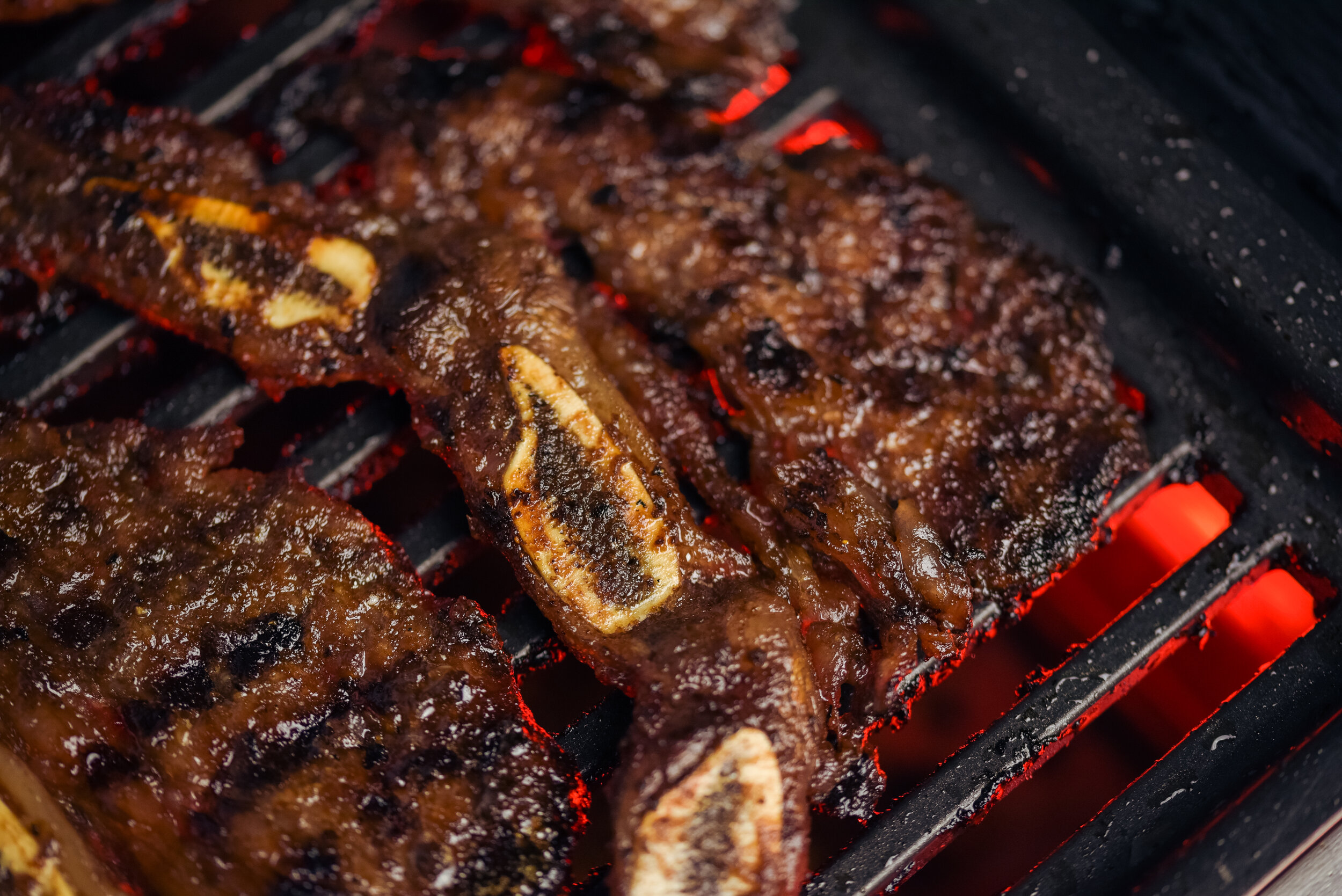
Korean BBQ have always been used as a way to celebrate milestones.
Korean barbecue has always been a house favorite. We use it for celebrating grades, birthdays, and in the work world to network.
THE DO NOTS
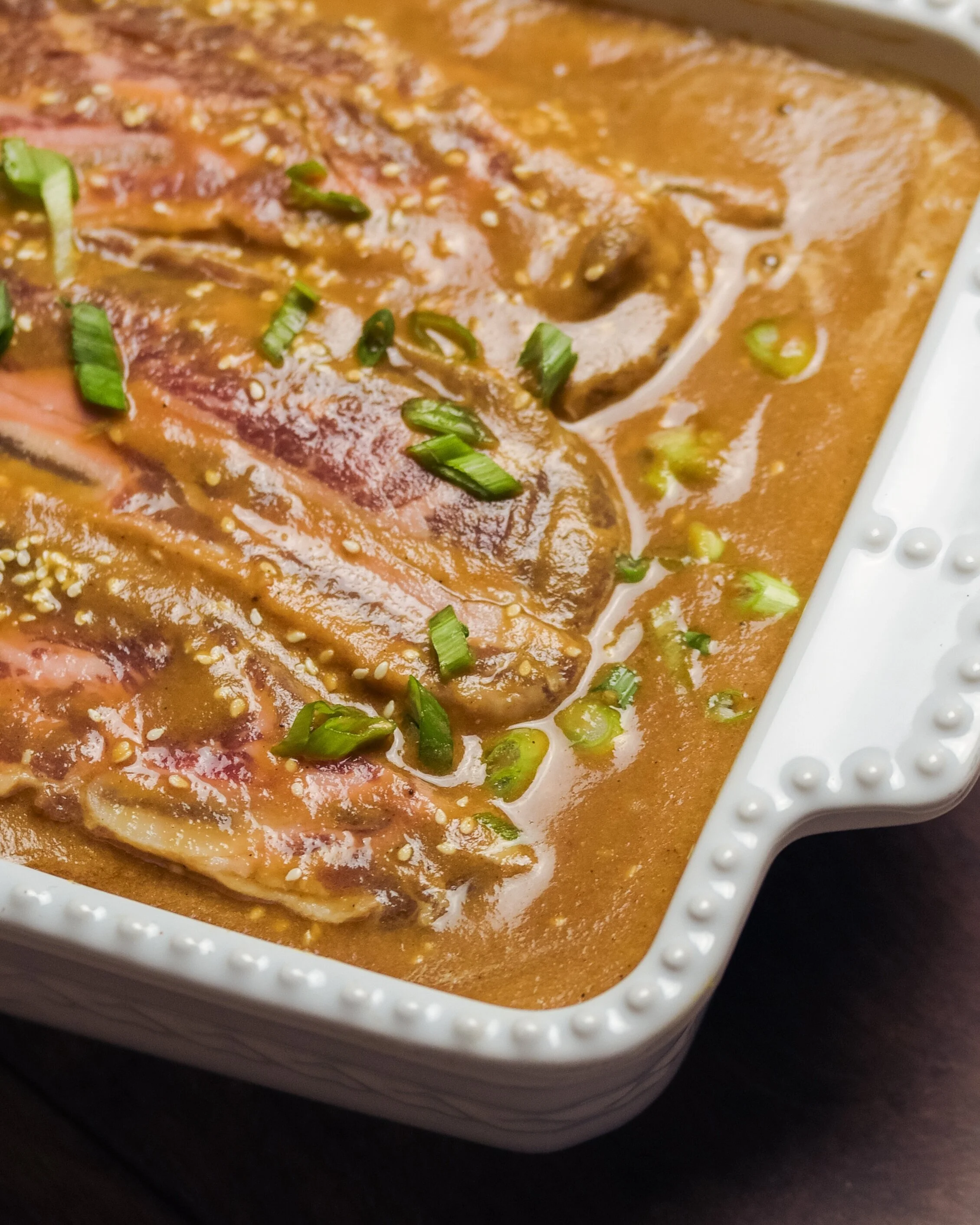
Korean galbi (kalbi) is perfectly marinated grilled short ribs cut crosswise. Also known as the flanken cut. This recipe is pretty full-proof, but just in case some helpful tips to ensure success.
Do Not over marinade.
Do Not cook on low heat.
Do Not cook straight from the fridge.
Do Not over cook.
MEET THE PLAYERS

Ginger and Asian pears help to break down the tough short rib to yield a tender BBQ.
Short Ribs
I really prefer the LA style ribs. Growing up we never called it LA style ribs, they were always just 3 short ribs cut flanken style. Now you see butchers cutting everything from 2 to 4 short ribs and making a mess of what used to be a beautiful flanken cut.
Look for thick cuts with good marbling. They should be roughly ½ inch thick with 3 bones across. The most important part being the thickness of these flanken strips and marbling. You want meat to bite into, anything thinner, doesn’t provide the unctuous mouthfeel that a thicker cut provides.
Asian Pear + Ginger
The acidic secret. Some will tell you it’s pineapple, papaya seeds, others kiwi, and some an Asian pear. I use an Asian pear because paired with ginger and sometimes Mom-mishaps, it’s a little more gentle than the latter.
Short rib is a slow braising type cut. They all contain some form of actinidin, while pears have a protease that acts as a meat tenderizer. Paired with fresh ginger and their specific zingibain protease, it helps break down tougher cuts of meat.
If you’re planning to leave the meat to marinade longer than 24 hours sub out powdered for fresh. The last thing you want is mushy meat. Fresh ginger is strong enough to break down tougher cuts, so be aware of potential life mishaps and plan accordingly.
SPECIAL TIPS
Resting
The most important thing to remember about working with meats is allowing them to sit for 30 minutes prior to cooking. If you’ve never rested your proteins prior to cooking, this is a game changer. It creates a juicy, more succulent, evenly cooked protein. Bottom line, it needs to come to room temp.
Draining excess liquids

It creates a safer and cleaner cooking environment. Nothing needs to catch on fire and clean up can be a little less chaotic. This is especially true if you opt to cook in the oven.
Your meats shouldn’t be sitting in the liquids they were marinating in. You know that thing that meat does when it gets grey scum when cooked in water? Well, cooking in the marinade will show you what that looks like. It’s not sexy or appetizing. So drain the liquid.
You don’t have to go crazy, but pulling it from the marinade and letting it sit for a bit will make your galbi game be on point. Cooking meat directly from the fridge is playing bbq russian roulette with expensive cuts and hard work. Just don’t do it.
HOW YOU SHOULD EAT THIS
You can eat galbi straight from the grill, but just like most Asian cultures, it’s much more refined than that. We have greens to offset the savory fattiness from the meat. Serve this with lettuce, perilla, cucumbers, ssamjang, rice and a variety of banchan.
쌀 | Ssal (Rice)
Short grain rice 100%. Real authentic Korean food IMO should be eaten with the appropriate rice. Jasmine rice is great for most Vietnamese food, but in Korean cooking it’s normally short grain rice aka mapssal also known as ssal (쌀). If you’re lucky and have a Korean friend who’s mixed a whole bunch of grains to create their own special rice blend even better. But short grain rice is the way to go.
쌈장 | Ssamjang (Dipping Sauce)
Whether you add rice to your lettuce or eat it on the side with your wrap, ssamjang is like the nuoc cham to the Korean world. You can apply the sauce to your lettuce wrap or dip it in, but either way you need ssamjang. It’s usually made with gochujang and doenjang. Buy it premade, or better yet make it at home.
반찬 | Banchan (Side Dishes)
These are little side dishes that are normally served ahead and/or come with your meal. They’re not necessarily appetizers as much as they’re a little bit of everything from condiments, and/or foods that complement and round out the meal.
Our must haves: kimchi. Like no one’s eating Korean BBQ without at the very bare minimum, kimchi. We also always have pickled daikon and carrots on hand, which is called musaengchae (무생채) in Korean.
If you live near a Korean market some of my favorites include:
감자조림 | Gamja Jorim (braised potatoes)
깍두기 | Kkakdugi (cubed radish kimchi)
어묵 볶음 | Eomuk bokkeum (stir fried fish cake)
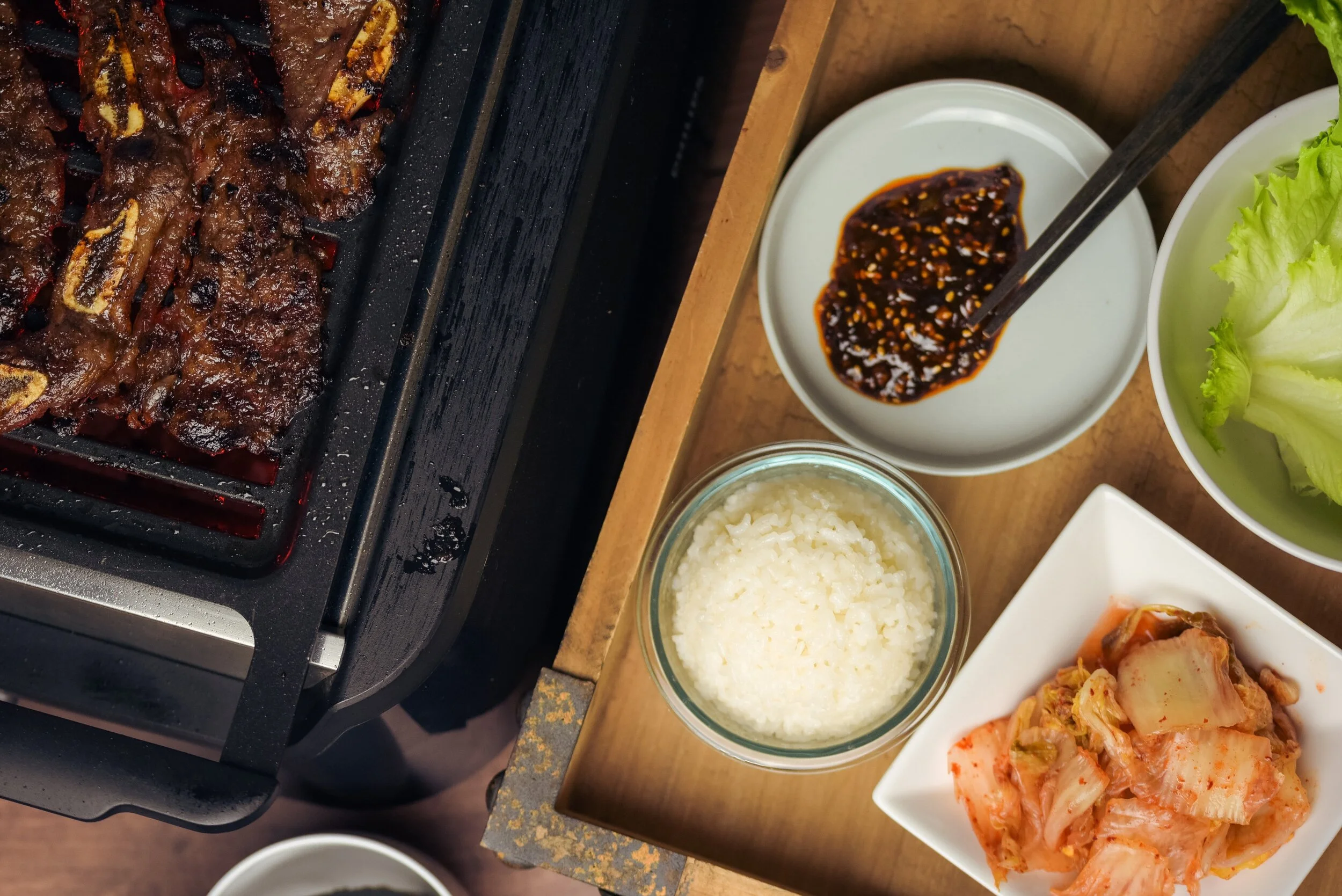
Korean BBQ should be served with short grain rice, ssamjang, and banchan.
FINAL THOUGHTS AND NOTES:
If you happen to be eating with some traditional Koreans, here’s a couple of easy pointers to show respect. Hierarchy matters, don’t lift your bowl (opposite from Vietnamese), two hands always.
I learned with business cards, pouring tea, or anything Korean related, use both hands when receiving or giving something. Again, don’t raise your rice bowl.
Be aware and set up your utensils. You know that little sleeve that comes with your chopsticks? If you know how, fold it into a little triangle bit to place your chopsticks down when switching to a spoon. Try to do it for the table or at least for the person sitting next to you- especially if they’re older. It will serve as a reminder to use one utensil at a time.
Never pour your own beverage, but pour everyone else’s - especially your elders. Pour with two hands and make sure to keep their cups full. They should not nor will they ask someone to pour. Much like most Asian cultures and fighting for the checks, we show our attentiveness, by making sure we are aware of when a glass becomes empty.
Which brings me to the last bit, if you’re the youngest, especially male, drinking with an elder, make sure to turn your face away while taking a shot or drinking your beer…
So much more, but that should at least put you in a good place to start.
LET’S GET STARTED!
&media=https://i.imgur.com/TE4YzHg.jpg)

갈비 | Galbi (Korean BBQ)
Ingredients
Instructions
Notes:
**For broiling techniques, make sure to pull the rack and put it in the upper ¼ of the oven. Preheat the oven to 450 degrees and allow it to come to a solid temperature for 30 minutes. Switch the temperature to a broil and line a baking sheet with tinfoil.
When ready to cook, place a rack on top and add short ribs. Roast for 3-4 minutes watching carefully not to burn. Flip and continue broiling for another 2-3 minutes or until desired doneness.


